Your first surf lesson is equal parts exhilaration and nerves, and that's completely normal. Surfing looks effortless when you watch someone lock into a wave, but the reality is structured progression. A good lesson breaks the complexity into manageable steps: water comfort, board handling, timing, and the pop-up. Most operators spend the first session building confidence in shallow water, not pushing you into overhead sets. You'll paddle out, fall repeatedly, feel every muscle you didn't know you had, and probably stand up at least once, even if just for a fraction of a second. The goal isn't mastery on day one. It's momentum. This guide walks you through the actual sequence, what instructors are watching for, and what to do when things don't feel smooth (which they won't, and that's fine).
Before You Paddle Out
Your lesson starts hours before you hit the water. The night before, confirm the meeting spot, tide time, and what gear the operator provides. Most schools supply a board and rashguard or wetsuit; verify the fit so you're not fidgeting in your own lesson. Pack a thick towel, sunscreen (apply 20 minutes before), fresh water, and a change of clothes, you'll be cold and damp for hours after even a 45-minute session. Wear something you don't mind getting salt-stained; avoid cotton, which dries painfully slow.
Choose a lesson location based on your actual skill level, not the Instagram aesthetic. Beach breaks with soft, rolling sand-bar waves are ideal for beginners; they're forgiving, slow, and wide. Reef or point breaks have longer, more powerful waves, saves those for lesson three. Many operators tailor lesson beaches to the day's swell and tide. When you book, ask the instructor to pick the spot; they know which break is gentle that morning. Arrive 15 minutes early. Instructors set up safety zones, check conditions, and do a quick interview about your swimming ability and any injuries. This is not small talk, they're assessing how much confidence-building versus safety-reminder your lesson needs.
The Warm-Up and Safety Briefing
Your instructor will likely start on the sand with the board in hand, not in the water. This is deliberate. You'll practice positioning: lying prone on the board, hands flat near your chest, chin neutral. You'll practice the pop-up motion, the explosive drive from prone to a crouch or standing position, ten or twenty times on the beach. It feels silly, but it builds muscle memory so your body knows the movement before the ocean's chaos arrives. Your instructor will demonstrate the correct hand placement (near your ribs, not near your head), foot position (one foot forward, one back, shoulder-width apart), and weight distribution (centered over the board's stringer).
Next comes the safety briefing. You'll learn to fall away from the board (never toward it), to protect your head, to recognize rip currents (and how not to panic if you drift), and basic ocean awareness. Most beginner lessons use waist-deep water initially, your instructor stays close, usually within arm's reach. You'll be told what to do if you're tired (signal, swim back, rest). Modern schools use leashes (the cord attaching you to the board) so the board doesn't wash to shore without you, and they'll explain how to avoid tangling. The goal of this beach phase is clear instruction, not rushing. A good lesson eats 15–20 minutes of safety and positioning before the first wave ever touches your board.
From Lying Down to Your First Pop-Up
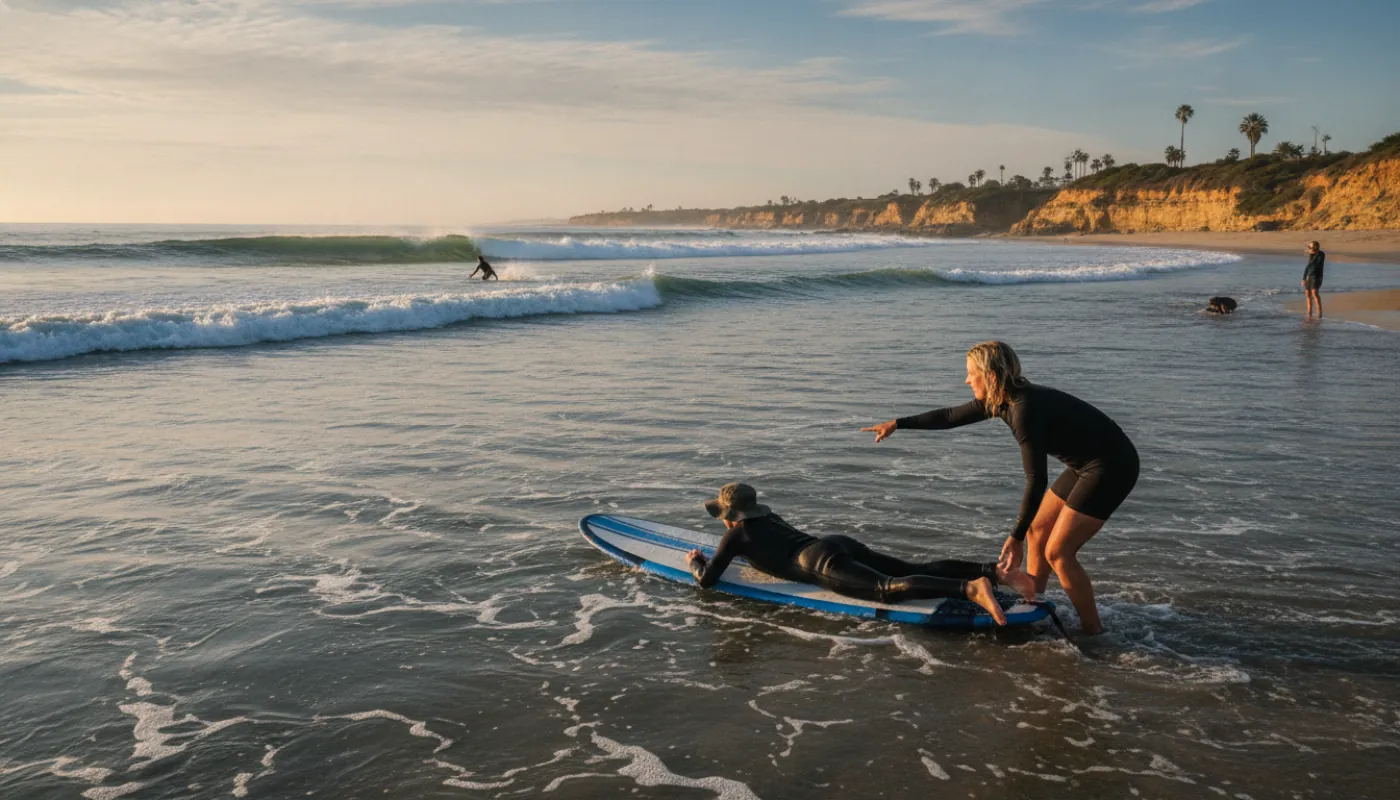
Once in the water, your instructor will push you into small, rolling waves while you lie on the board. Your job: feel the board accelerate, recognize the timing, and pop up. The first attempts are chaos. You'll be too slow. You'll stand sideways. You'll overcorrect and fall immediately. This is universal, every surfer has done it. What matters is that you're learning the rhythm: feel the wave's push, generate explosive upward momentum, land in a surfing stance. Your instructor will catch you, reset you on the board, and push you into the next wave. Most beginners land their first standing pop-up, even if brief, within 15–20 minutes of practice.
As you build pattern recognition, your instructor will gradually give you more responsibility. They'll position you on the wave, you'll generate the paddle-power, they'll guide the pop-up mechanics. Then they'll let you paddle slightly earlier, place your hands on the pop-up without their hands under you, and finally, you'll do a wave from start to finish with minimal coaching. You won't ride down the line. You might not even stay standing for more than a few seconds. But you've now traced the journey: paddle, feel, pop, balance. That's everything. Some instructors progress to having you turn the board toward the beach and paddle after the wave passes, deepening your sense of board control. Others call it after several successful pops and let your legs absorb the magnitude of what just happened.
Understanding the Feedback and Reading Your Mistakes
Instructors don't yell critiques underwater. They give feedback in the moment ("Earlier pop," "Move your back foot back," "Bend your knees"), or between waves while you're catching your breath. These aren't failures. They're data. Every beginner's pop-up is late, or their stance is too wide, or their eyes are looking at their feet instead of down the wave. The instructor is trained to spot these patterns and prioritize. In a 45-minute lesson, they might focus on one or two mechanical fixes, not ten. Listen for the repeated note; it's the thing your body most needs to learn.
Common beginner mistakes: popping up too vertically (should be a crouch first, then rise), looking down instead of forward (kills balance and direction awareness), tensing up (makes you rigid and exhausted), and abandoning the board when it gets wobbly (it's supposed to wiggle, you're learning to manage that). Your instructor will normalize these. They might even exaggerate a mistake in front of you ("See, if I jump straight up?"), to show why the mechanics matter. This is teaching, not criticism. You'll also discover that your forearms, shoulders, and core are on fire. Paddling is harder than it looks. This is normal. Most operators ease pace if you're clearly gassed.
After Your Lesson: What Comes Next
When your lesson ends, you'll likely be exhausted and buzzing simultaneously. The adrenaline will fade by evening, and soreness will arrive tomorrow. That's part of the journey. Ask your instructor for a debrief: What did you do well? What's the one mechanical thing to focus on before your next lesson? Should you book again immediately, or take a day to recover? Some people crave a second lesson within days; others need a week. There's no universal rule. Your own comfort and budget decide frequency.
Most instructors recommend three to five lessons before you're truly "ready" to paddle out independently and find your own waves. By lesson three, many surfers can catch waves consistently, maintain balance briefly, and have enough spatial awareness to avoid other people. By lesson five, you're thinking about direction and speed, not just staying upright. This is operator-dependent, a skilled instructor can compress the timeline; a busy school running high-volume lessons might extend it. The progression is personal. Some people spend weeks at beach breaks before moving to faster, more technical breaks; others progress rapidly. The honesty is: your first lesson ends with you soaking wet, muscles activated, and a fundamentally new understanding of how the ocean and a board interact. Whether it lights you up or terrifies you in the best way, you've started. Everything else is just repetition and patience.