Choosing your first progression board is rarely a casual decision. The gap between a foamie and your next ride often feels impossibly wide, a wall of options defined by obscure measurements and contradictory advice from the locals. Yet the right board choice accelerates progression; the wrong one creates frustration that stalls growth for months.
The truth is simpler than it seems: board selection hinges on three variables that don't change: your height and weight, your current ability in the water, and the type of breaks you'll surf most. Everything else (the shaper's reputation, the graphics, the price), ranks far below. This guide walks through those three variables so you can land on a board you'll actually want to paddle.
Longboards, Shortboards, and Funboards: What Each Does
Each board type exists to solve a specific problem in the water. A longboard floats you effortlessly and lets you pop up from nearly anywhere on the wave face. A shortboard demands precise positioning and explosive pop-ups but turns on a dime and holds a line in steep walls. A funboard splits the difference, easier to paddle and catch waves than a shortboard, more maneuverable than a longboard.
Longboards excel in small, rolling beach breaks where the wave dies gradually. You can take off from 20 feet back, walk the nose, and still drive forward through forgiving shoulders. Their volume forgives positioning errors and rewards smooth style over athleticism. A 8-foot to 9-foot longboard carries 70 to 90 liters of flotation, nearly twice what a similarly-sized person needs, which means wave catchability remains absurdly high even in mushy conditions.
Shortboards (5'6" to 5'10") consolidate buoyancy into narrow outlines with thin rails and pointed noses. They demand that you earn every wave: you must paddle hard, position yourself in the pocket, and time your pop-up precisely. In return, they reward that effort with responsiveness. A shortboard bends to your intentions in a way a longboard never will, pivoting on the tail and holding critical sections that look impossible on longer boards. Shortboards belong in consistent, sculpted waves where the shape and power justify their demands.
Funboards (6'0" to 6'8") bridge the gap. They carry enough volume to paddle easily and catch waves with minimal effort, but their slightly wider nose and fuller outline give them pivot capability closer to a shortboard's. A funboard works for surfers still building paddle fitness or progressing between boards, and for anyone who wants to ride quality break-types without the extremes of either camp.
Matching Board Type to Where You Surf and Your Current Level
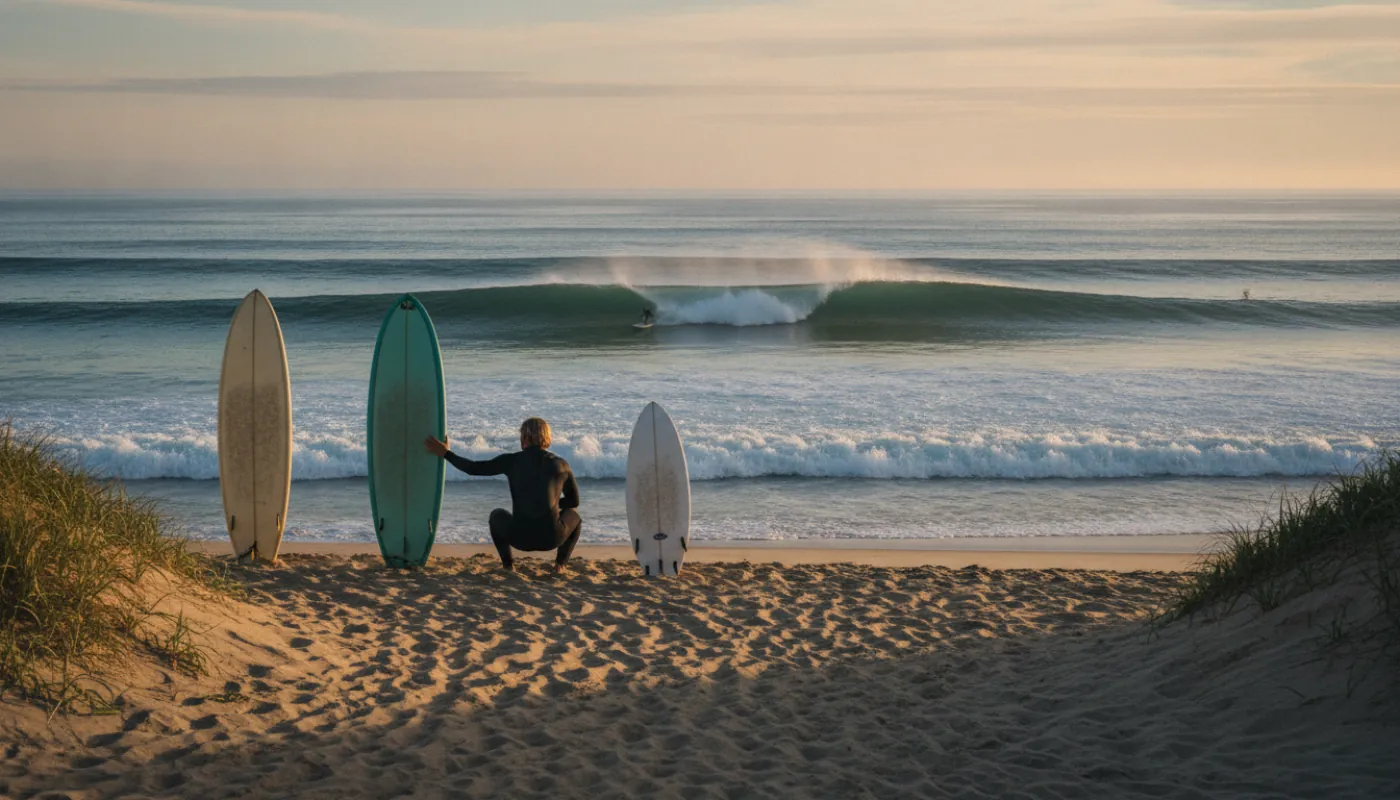
Your skill level and home break type should drive which category you live in, not the reverse. A beginner at a powerful reef break needs a shortboard's positioning precision even though she'd be better served by a longer board's flotation, the wave shape demands it. A skilled surfer at a rolling beach break might love riding a nine-foot log for pure fun, regardless of formal ability level.
Beginners typically belong on longboards or soft-tops if their local break is small and mushy: think beach breaks with 2 to 4-foot rollers, shore breaks with sand bottoms, or slow point breaks. Your wave-catching capacity matters more than rail-to-rail speed here, and a longer board's forgiving geometry means you can focus on balance and timing rather than paddling power. Plan to spend 1 to 2 years riding something in the 7'6" to 8'6" range before progression feels natural.
Intermediate surfers ready to progress, perhaps 12 to 18 months into riding regularly, often find a funboard or short hybrid (6'0" to 6'4") opens new possibilities. If your home break is a reef or point that holds shape and walls, a shorter, narrower board pays immediate dividends. If you're still learning on varied conditions, a funboard lets you chase better waves without abandoning accessibility. This is the window where board choice begins to shape your style: riders who pick a funboard here often stay fluid and adaptable; those who jump straight to a narrower shortboard sometimes become locked into particular break-types.
Advanced surfers should chase the specific break first and choose the tool second. A pool of 50-plus surfers at a heavy reef might all ride 5'4" to 5'8" thrusters with identical rocker and bottom contours. The same skill level at a mellow point break might split across 6'0" to 7'0" boards with entirely different characteristics. Your progression board at this stage isn't about learning to pop up, it's about owning a particular wave type.
Volume, Dimensions, and the Numbers Game
Board dimensions matter, but only in context. A 6'0" shortboard and a 6'0" funboard are not interchangeable despite the matching length. The shortboard might displace 26 liters of water; the funboard, 35. Volume, measured in liters, is the single best indicator of a board's paddle power and wave-catchability. Your body weight and desired riding style determine how much volume you actually need.
A rough starting point: volume is sized against your body weight in kilograms, not pounds. Beginners want roughly 0.9 to 1.3 liters of volume per kilogram of body weight; a 73-kilogram (160-pound) beginner lands somewhere around 90 to 100 liters on a buoyant soft-top, plenty of flotation to stay horizontal and relaxed during paddle-outs and pop-ups, which is exactly why beginner boards are long and thick. (This is the same idea behind the 70-to-90-liter longboard above: high volume relative to body weight is what makes a board forgiving.) Intermediate riders often drop toward 0.4 to 0.5 liters per kilogram as they develop power and positioning, roughly 30 to 36 liters for that same 73-kilogram surfer. Advanced surfers ride as low as 0.25 to 0.4, accepting that wave-catching requires precision rather than flotation advantage. Every major shaper publishes an online volume calculator that turns your exact weight and ability into a target range, use one before you buy.
Boards are also described by their three main dimensions: length (nose to tail), width (widest point), and thickness (top to bottom). A wider, thicker board at the same length carries more volume. A narrow, thin board at the same length displaces less. Length sells the dream, everyone wants the magic 5'8" shortboard they watched on a film, but width and thickness determine whether that 5'8" board actually floats you or leaves you paddling into a wall.
When shopping, always cross-reference length with volume. A 5'8" board at 28 liters is a lean, responsive shortboard. The same 5'8" at 35 liters is effectively a stubby funboard with a shortboard's length. Both can be perfect for the right rider; they're not the same tool. Don't get hypnotized by length alone.
Testing and the Rental Approach
Before dropping money on your next board, rent or borrow 3 to 5 candidates over 2 to 3 weeks. Paddle each in the breaks where you spend most time. How did you feel during paddle-outs? Could you generate speed without muscling, or did you labor? Where did you catch waves, how early? How late? How did the board feel during turns, was it responsive or sluggish? Did your feet ever slip off the tail?
Rental feedback is worth weeks of online research. A board that seems perfect on paper might feel twitchy in overhead waves or sluggish in small surf. Conversely, a shape that sounds gimmicky (a wider funboard, an extra-thick mid-length), might reveal itself as the exact tool you'd been missing. Bring a notebook and write down one sentence after each session. "Paddles easy, turns slowly" or "poppy rail-to-rail, paddled to death" are more useful guides than star ratings.
This testing phase also prevents the most common mistake: buying down in volume too early. A surfer at the 1.5x-weight window who borrows a 1.1x board for a week might land it because the conditions were perfect and the wave type was ideal. That same board in everyday conditions often becomes an anchor, killing progression because you're too busy fighting fatigue to focus on technique.
Your next progression board should feel one size too easy for 60 percent of the conditions you'll face, adequate for 35 percent, and genuinely challenging for 5 percent. That discomfort zone, the 5 percent, is where growth happens. But the board shouldn't spend most days in the fight-and-survive column. Choose on that basis, and you'll find yourself paddling out more often, progressing faster, and actually enjoying the session.