Indonesia has earned its place as one of the world's great surfing destinations, but its reputation is built largely on heavy, shallow-reef barrels that demand advanced skill. The good news for intermediate surfers is that the same archipelago also holds long, mellow points that reward solid technique without punishing hesitation. The trick is knowing which is which. Point breaks dominate here, and for good reason: they peel off predictably, offer multiple entry points, and force you to think about wave selection instead of just paddling into whatever's in front of you. This guide is honest about both ends of that spectrum: the genuinely intermediate-friendly point at Medewi, and the world-class but advanced reefs (G-Land, Uluwatu, Padang Padang), that you should aspire to rather than charge before you're ready.
Why Point Breaks Work for Intermediate Surfers
Point breaks set the standard for progression because they demand precision without requiring the deep breath of a barreling reef. A point break wraps around a peninsula or rocky outcrop, and the wave unfolds laterally, sometimes for 30 seconds or more. That extended face gives you time to think: time to set your line, adjust your pop-up, practice your bottom turn without the wave closing out in your face in four seconds.
The other advantage is consistency. A point break is anchored to geography. Swell wraps around the point in roughly the same way every time, which means you can study a break across multiple sessions and actually build intuition. You'll start predicting where the barrel will pitch, where the wall steepens, where a wave will section and rebuild. Beach breaks shift daily with sand; point breaks are as reliable as a gym. You can trust them.
Indonesian point breaks also graduate you to reading swell direction and frequency. You'll learn why a southwest swell works better than south, why the first dawn patrol set is cleaner than afternoon, why certain points work best in certain months. These aren't abstract concepts, they're real patterns you'll see playing out in front of you over a week or two.
G-Land: A World-Class Point Break (Advanced)
Grajagan Bay, or G-Land, sits on the eastern tip of Java and is one of surfing's most celebrated point breaks, but be clear-eyed about what it is: a long, powerful, shallow-reef left that draws experienced surfers from around the world. The bay faces nearly due south, and when a southern hemisphere swell lines up, the waves peel off in orderly, predictable lines over coral. The entire bay is one long point, and depending on swell size and direction, the zones range from the slightly more forgiving shoulder near the boat landing to the hollow, hard-breaking peaks mid-bay and the heavier walls further out. It is not an intermediate playground. Even the "easier" sections demand confident reef surfing, and on a solid swell G-Land is squarely an advanced wave.
If you are an intermediate surfer, treat G-Land as a spot to watch and aspire to rather than one to charge. The lessons it teaches (how a southern-hemisphere swell moves through a bay, how tide reshapes a point), are worth studying even from the channel. Conditions shift with the tide: low tide exposes shallower, more critical sections over the reef; high tide opens up deeper channels. The crowd can be heavy during peak season, but a small group of guests and boat operators respect the break enough to keep things civil. Most access to G-Land is through land-based resorts or boat charters, both of which include guides who know the break cold.
Water temperature runs warm year-round, typically 79–84 degrees Fahrenheit, so you'll ride in board shorts or a thin rashguard. The reef, not cold water, is the hazard here: it is shallow and unforgiving, and wipeouts have consequences. If you're stepping up to a wave like G-Land, do it with a guide, on a smaller, cleaner day, and only once you're comfortable surfing reef over coral.
Uluwatu and the Bukit Peninsula (Advanced)
The Bukit Peninsula, Bali's southern hook, is ringed with point breaks, and Uluwatu is the most famous of them, a world-class wave, but an advanced one. The break peaks at Ulu's main point, where waves wrap around a rocky headland and peel down a long wall over shallow reef. The face is clean and defined, but the takeoffs are steep and the consequences of a bad wave are real: you paddle out and in through a cave, the reef is sharp, and the lineup is competitive.
Uluwatu works across a wide range of swell sizes, and even on smaller days it rewards confident reef surfing far more than it forgives mistakes. Padang Padang, just west along the same peninsula, is even more demanding: a heavy, hollow, dredging left over shallow reef so renowned for its barrel that it's nicknamed "Bali's Pipeline." Despite the protected-cove look, it is one of the most serious waves on the island and is strictly expert terrain. Nearby Bingin and Impossibles are likewise punchy reef waves. None of these are intermediate spots. The Bukit is worth visiting to watch the best surfers in the water, but if you're an intermediate, surf elsewhere and step up here only when you genuinely surf reef with confidence, always with a local guide reading the daily conditions.
Medewi: The Genuine Intermediate Point
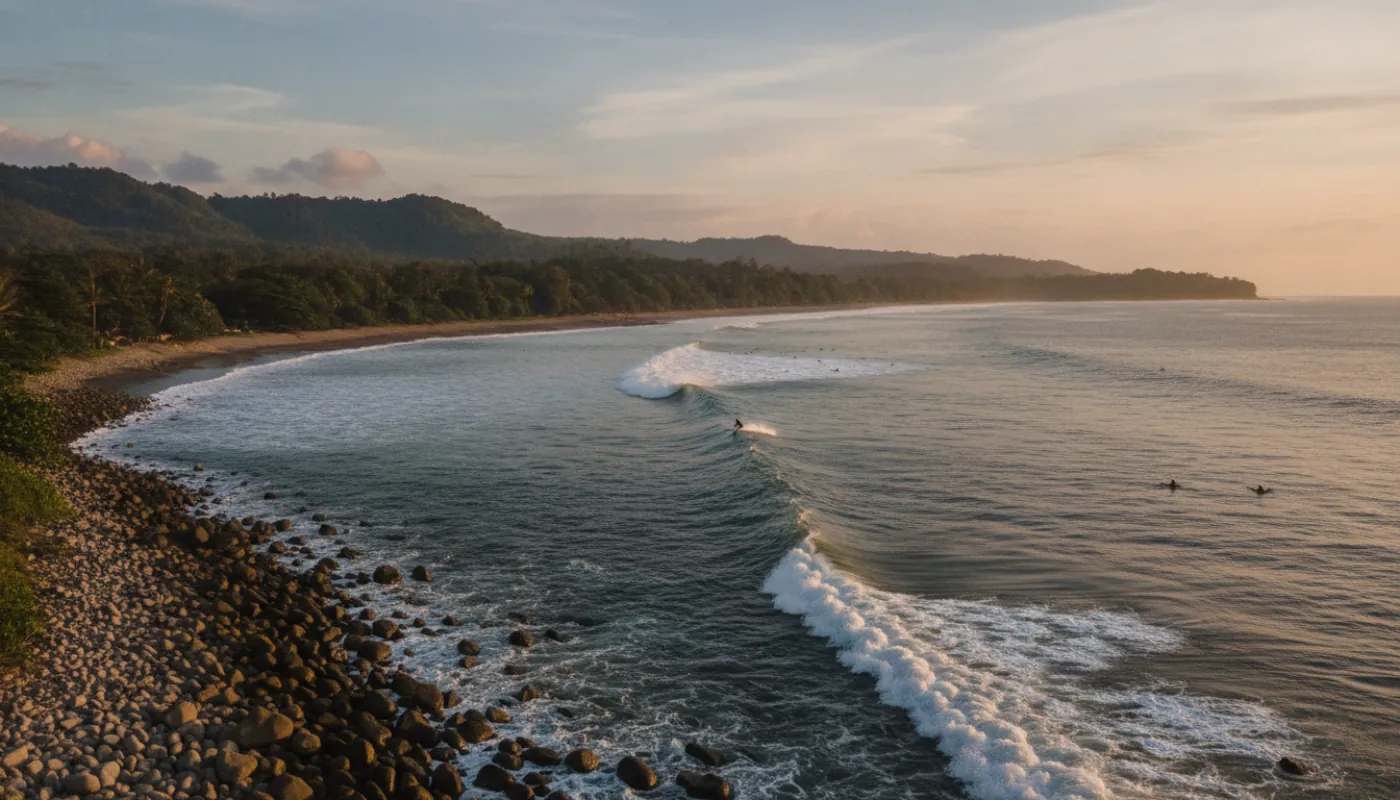
If you want a point break in Indonesia that actually suits an intermediate, head up Bali's west coast to Medewi. Almost unique on the island, it's a long, mellow left that rolls over a boulder-and-cobble bottom rather than sharp coral, on its best days the wave holds shape for hundreds of meters, giving you one of the longest rides in Bali. The takeoff is slow and the wall is forgiving, which is exactly what makes Medewi a place to build technique instead of just survive a drop.
This is the break where the progression lessons in this guide pay off. The slow speed gives you time to set your line and work on your bottom turn; the long ride builds the paddle fitness and wave-reading you'll need before you ever think about stepping up to a reef. It works best on the same May-to-September dry-season groundswell that lights up the south coast, and mid-to-high tide is generally the safest and longest. Medewi sits well away from the Kuta and Canggu crowds, so the lineup is quieter and the vibe relaxed, an easy place to log session after session. Beginners can find their feet here on smaller, higher-tide days, but it's the novice-to-intermediate surfer who gets the most out of it.
Indonesia's two seasons work in opposition. The southern-hemisphere winter brings ground swells from the Southern Ocean, typically May through September. This is when G-Land and the southern coast of Java come alive. These swells are predictable, organized, and often come in multi-day windows of clean conditions. Water is coolest during this period (still warm), around 79–81 degrees, dipping toward 77 where Bukit upwelling kicks in.
The opposite season, October through April, is the northwest monsoon (the wet season). Southern Ocean groundswell still arrives, but the northwest winds now blow offshore on Bali's east-facing coast (Nusa Dua, Sanur, Keramas), so those breaks come alive while the Bukit gets blown out. Many intermediate surfers still prefer the May–September window, when the Bukit's primary swell delivers the most consistent, user-friendly conditions.
Shoulder seasons (April and October) can be hit-or-miss. Wind patterns shift, swell direction is less predictable, and you may find yourself on a break that's working but not peaking. Tourist crowds are also lower during shoulder seasons, which some surfers prefer for the solitude.
Preparation and Etiquette
Flying to Indonesia requires a valid passport and usually a visa on arrival (for US passport holders). Costs are modest, but there's no nonstop from the US. Expect 20-plus hours of total travel from the West Coast with at least one connection (typically Singapore, Taipei, or Hong Kong). Bring a well-maintained board and a spare, ding repair in Bali is reliable but slow, and you don't want to lose a week of travel to a board emergency. Board shorts, rash guards, and sunscreen are your essential kit. Many surfers skip wetsuits entirely; a thin spring suit is useful only if you're sensitive to cool water or plan extended sessions.
Respect the break. Point breaks attract tight-knit local and visiting communities. Avoid paddling into someone's wave, wait your turn, and read the break before your session. Watch for ten minutes from shore if you're unfamiliar with the lineup dynamics. Most injuries on Indonesian point breaks come from inexperienced surfers misjudging the commitment required to commit to a 30-second ride; if you're unsure, let the wave pass.
Insurance matters. Evacuations from remote breaks are expensive; a travel policy that covers water sports is not optional. Dehydration is the most common on-trip problem, the tropical heat and long paddling sessions delude you into thinking you don't need water, then hits you hard. Drink obsessively between sessions. And finally: respect the tide. Many Indonesian points are only rideable in a narrow window around high or low tide. Ask locals, check tide charts obsessively, and plan your day around the water's rhythm. Indonesia rewards surfers who study before they paddle.